No matter how you slice it, a Pull on your AERC record can reflect hours, days, if not weeks and years of torment. From the tiniest bad step walked off the next day to the most tragic of consequences, a Pull means something went wrong with your horse partner, and I can’t speak for everyone but I will say that *that* is my personal worst nightmare as an endurance rider and something that doesn’t leave me.
Of the two pulls, Metabolic or Lameness, Metabolic screams to me as worse. Many many riders have lameness pulls on their records and seem to accept it as an unfortunate side affect–as one ride vet said, “If you haven’t been pulled yet you haven’t been riding long enough.” That’s not to suggest a cavalier attitude about lameness in the least, merely that with that so many miles ridden, horses are at a much higher risk for lameness, period. We can all dream of perfect ride records and horses lasting thousands of miles virtually unassisted but for our hay delivery/back-sitting-on skills, but it’s not the reality for the vast majority.
Which brings me to the big, ugly ‘M’ on my ride record:
http://aerconline.org/erol/Individual/rhReport.asp?aeMbrID=31609&Rider=Grohman,+Aurora
Yep, not only do I have a Metabolic pull–it was on an L.D.!! Shocking, right? Embarrassing? Kinda. Ready to dismiss me as a complete idiot? Find the x in the upper right corner if you must.
I can boil down the entire story to 3 simple words: I. Fucked. Up. Here, let me hit you with 7 more: Let That Be a Lesson To You. May someone read this and avoid my mistakes–which is the entire reason this blog exists really.
****************************
So HOW did an otherwise intelligent, informed, well meaning experienced horse owner who had already finished 3 LDs, top 10’ing 2 of them, end up with a Metabolic pull on an LD? Noo really, how!
*I rode my horse like he was the horse I used to ride*
I hope that resonates as profoundly with you reading it as it does in my brain. Because really, that experience cemented that forever, epically, in my head. I certainly wish I’d just been smart enough to know better, or finished the ride with a happy, if tired, horse. That simply didn’t happen and fortunately Blaze was just fine, so I will hold on to and share this lesson from now til eternity.
My first two horses were forward, feisty mares, well suited for a wild teenager who liked to “condition” by cantering around the woods for hours like a lunatic. I rode long and fast and that’s how I rode and finished the LDs. Fair enough, the mares finished in fine fettle and asked for more; one was Appendix and the other Welsh Pony/QH and they would have both done just fine at 50s. I didn’t get that opportunity to bump up distances with either of them, unfortunately, and some years passed before I got to attend an endurance ride again.
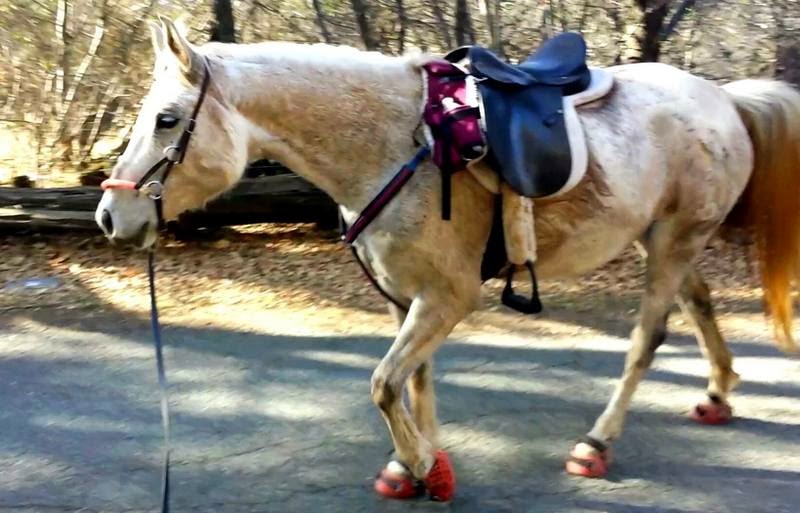
In 2009 I attended the Lake Oroville Vista endurance ride in my new home town, with my new gelding, Blaze. We’d been riding alone in the foothills all summer and I figured he was pretty well physically ready to finish an LD at the pace we’d been riding at home. Yes, as you experienced endurance riders probably caught, the last part of the previous sentence was the fateful one: “physically ready to finish an LD at the pace we’d been riding at home.” Since this was Blaze’s first LD, he had no plans of riding the controlled pace we’d been riding at home, and also notice how I didn’t specify that he was *mentally* ready. Riding alone at home does not an endurance horse make! There is so much going on from the dynamics of camping in a charged atmosphere, to the vet exams (is your horse comfortable being handled all over by men and women, some more polite than others, really?), to the herd dynamics on the trail where the horse must leave others and be left.
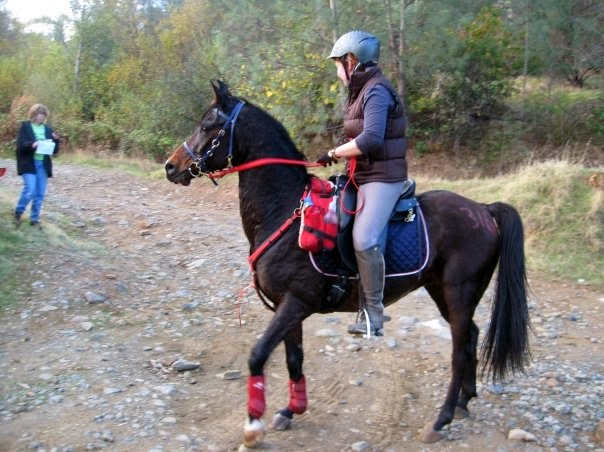
I started the ride as if I were on my fast, fearless mares. They said controlled start and be there on time, so I was. Up front and ready to go. To this day I’ve never seen a ride start so fast, as riders literally cantered and hand galloped out of the start. Oroville has some rocky bits and I was floored at the rate of speed we were riding. Oh yes, we were riding that fast too, because Blaze was in the middle of the hot shoes and losing his mind. He and I fought for anything less than a literal gallop for the first ten miles. Nope, not exaggerating, I know the trails well and have GPS’ed them to death, that charming little 14 hand bugger fought me like a 20 hand monster for 10 solid miles.*
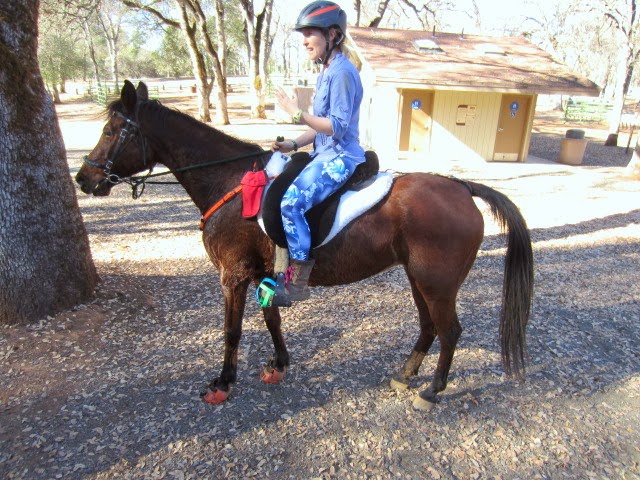
No pro ride photo but Josh waited along the trail and got this of us giving our # … niiice ugly neck and hollow back Blaze, sigh, haha!
I was completely and utterly exhausted at mile 11 but we zoomed into the 15 mile vet check and passed with flying colors, getting 2 thumbs up from the vet who was seeing a lot of tired horses already. We headed out of the check on time behind the mare I’d finally managed to tuck behind (after asking if the guy minded) but the last few miles to the finish had us climbing the Oroville dam *again* on the steeper side, and Blaze just ran out of steam. We’d both given it everything we had to stay alive in our respective ways the first 10 miles, and knowing what I know now of managing Blaze through an LD, we didn’t have a prayer of finishing. Eating and drinking weren’t even near on the list in those first 10 miles, when he needed it. Thank goodness he drank and ate at that 25 mile vet check but his pulse hung in the 60s and that was that. I was crushed that I’d overridden my horse and had that torturous trailer ride back to camp when we were only 5 miles from the Finish. We stayed the night and Blaze was just fine so we headed home early in the a.m. and I never, ever, forgot it.
It was absolutely my error in taking a horse that was mentally unprepared, and starting him in the insanity of the front of the pack. I’ve since brought a couple of horses along through the process and am sure to pay attention to where they are mentally as well as physically, and practice group riding and whatever scenarios I can at home–and I always do my best to leave ride camp for the Start dead last. Be sure to fit your riding and training strategies to each individual equine, but “slow” and “cautious” are good general headings to fall under!
*at that point I hadn’t yet ridden my Haat Shaat mare who would fight me for 50 solid miles! 😉








 Redheaded Endurance